
Social credit
Social credit is a concept that has been used since the late 20th century to describe a form of credit designed to meet the needs of a segment of the population at risk of financial exclusion and, as a result, sometimes social exclusion.
Social Credit and Pignus
In addition to the pawnbroking services characteristic of PIGNUS members, this credit includes other initiatives, the most important of which is microcredit—a financial model that enables the most disadvantaged to access the means of production without the need to provide collateral or personal guarantees. In the case of microcredit, the guarantee is both a business project with prospects for success and long-term sustainability and the person presenting it.
At the beginning of the 21st century, the concept of “social credit” was introduced into our Association and even added to its name. This occurred primarily for two reasons. The first is that, since its foundation, PIGNUS has always considered pawnbroking to be a financial activity with a clear social orientation. The second is that some of its members were beginning to play a significant role in granting unsecured social microcredit.
This is the case, for example, with certain French Municipal Credit Unions and, above all, with “la Caixa” in Spain, which created a bank dedicated exclusively to granting microcredit called Microbank de la Caixa, now the European leader in this sector.
Microcredit
What is microcredit?
Microcredit is an economic development tool that provides access to financial services for people living in poverty and facing social exclusion. It is defined as “a small loan intended to support the start-up of a business or t cover emergency expenses, granted to socially and economically vulnerable individuals who are generally excluded from the formal financial sector.” However, international perspectives and practices place less emphasis on social vulnerability and more on market sustainability: “Microcredit is not philanthropy—or at least not solely so. It is based on the assumption that the money lent will be repaid and that the lender can continue to operate over time. Loss risks must therefore be kept under control. The effectiveness of the model and its ability to reach an ever-growing audience depend on it.”
In developing countries …
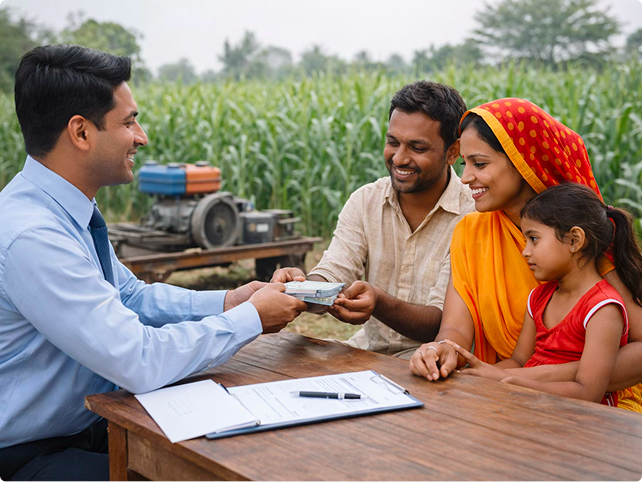
In developing countries, millions of families rely on income from their small-scale agricultural businesses and cooperatives within what is known as the informal economy. The difficulty in accessing bank loans—due to inadequate or lack of collateral and the small size of these businesses, which traditional banks consider too small—prevents these productive activities from starting and developing independently of usury. Microcredit programs offer alternative solutions for these microenterprises.
The earliest origins of microcredit can be traced back to the 1930s and 1970s with the emergence of international development banks (such as the World Bank and regional institutions). However, modern microcredit dates back to 1976 with the founding of the Grameen Bank in Bangladesh, which later evolved into Grameen Bank 2, offering greater flexibility in repayment plans. Given its proven effectiveness in numerous cases, the United Nations declared 2005 the International Year of Microcredit.

In developing countries …
In developing countries, millions of families rely on income from their small-scale agricultural businesses and cooperatives within what is known as the informal economy. The difficulty in accessing bank loans—due to inadequate or lack of collateral and the small size of these businesses, which traditional banks consider too small—prevents these productive activities from starting and developing independently of usury. Microcredit programs offer alternative solutions for these microenterprises.
The earliest origins of microcredit can be traced back to the 1930s and 1970s with the emergence of international development banks (such as the World Bank and regional institutions). However, modern microcredit dates back to 1976 with the founding of the Grameen Bank in Bangladesh, which later evolved into Grameen Bank 2, offering greater flexibility in repayment plans. Given its proven effectiveness in numerous cases, the United Nations declared 2005 the International Year of Microcredit.
Social Microcredit
Social microcredit promotes a culture of responsibility by replacing non-repayable grants with actual interest-bearing loans.
These loans encourage borrower accountability and aim to significantly improve their financial situation while preventing future imbalances.
Furthermore, social microcredit can serve as a foundation for further development, whether in the form of business microcredit or access to standard credit.
Once the initial phase of difficulty has been overcome, beneficiaries may be able to launch a self-employment initiative or a microenterprise, generating sufficient income and gaining access to additional forms of credit.

To support the dissemination of social microcredit, PIGNUS maintains relationships with several international forums in the sector, in particular with the European Microfinance Network.